Furniture
Pillory
also known as Head-and-Hand Pillory, Standing Pillory, Public Pillory
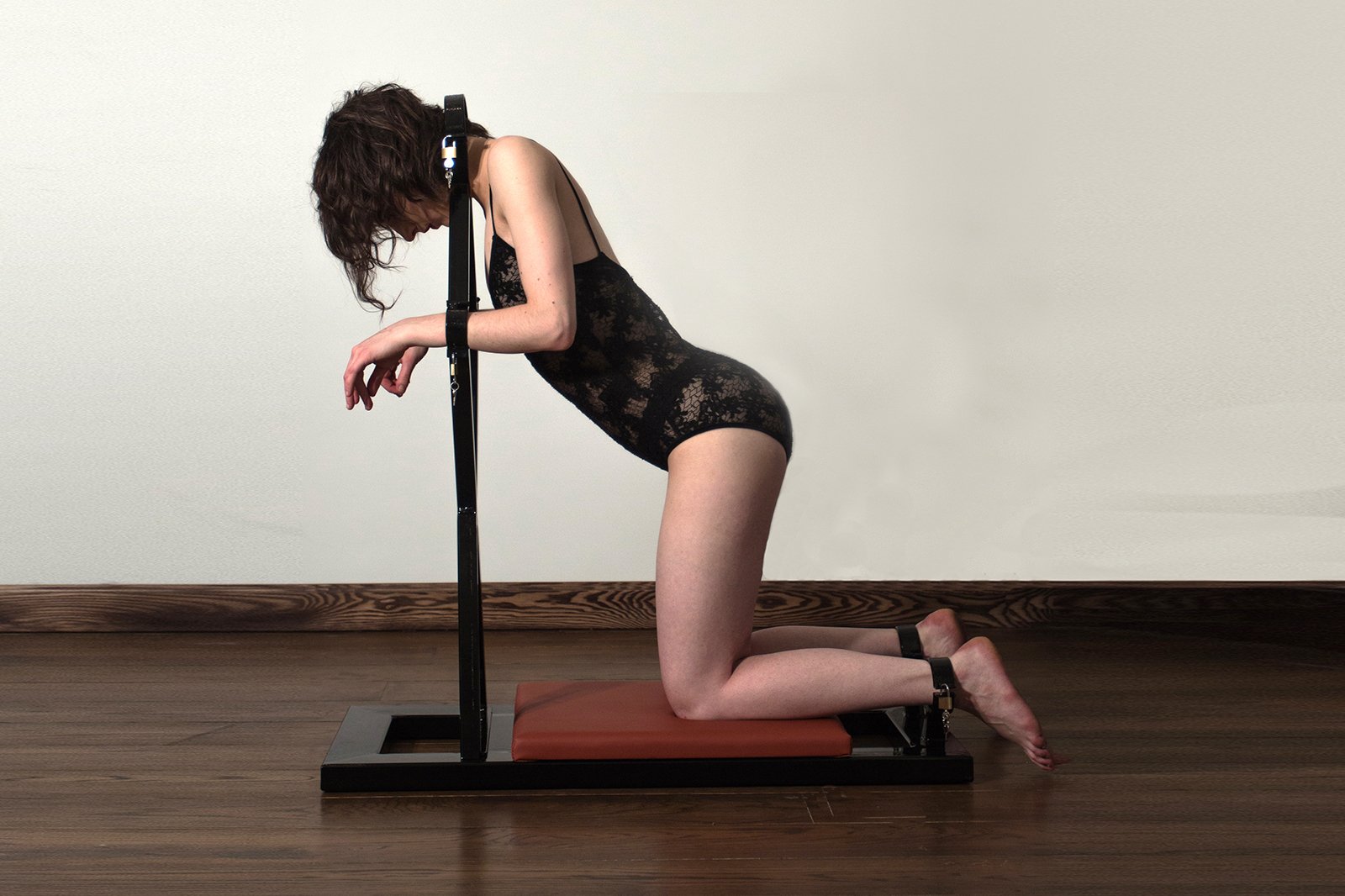
A Pillory is a freestanding restraint structure historically associated with medieval and early modern systems of public justice. Distinguished by its upright design securing the head and hands, it later became an architectural reference adopted by some Leather and BDSM communities as specialised ceremonial furniture within consensual authority environments.
- Materials
- Hardwood, oak, elm, ash, pine, steel, wrought iron, brass, iron hardware, stone foundations
- Origin
- Medieval Europe; later reinterpreted within contemporary Leather and BDSM communities as specialised architectural furniture inspired by historical forms.
- Period
- Medieval origins; incorporated into Leather and BDSM culture primarily during the late 20th century.
- Tradition
- Leather, Old Guard, Contemporary BDSM, FemDom, MaleDom, M/s, Professional Domination
Description
The Pillory is a vertical restraint structure traditionally consisting of an upright wooden frame fitted with hinged boards containing shaped openings for the head and hands. Unlike Stocks, which are generally positioned close to the ground and primarily secure the feet or hands, the Pillory presents the individual in an upright position, making the structure highly visible within its surrounding environment.
Historically, Pillories were substantial civic installations constructed from heavy timber and reinforced with iron fittings. Many were permanently erected in market squares, outside town halls or near courthouses, where they formed part of the public architecture of justice.
Within contemporary Leather and BDSM material culture, the Pillory has been reinterpreted as purpose-built architectural furniture. Modern examples often combine traditional woodworking with contemporary engineering, decorative carving, forged hardware and custom finishes, transforming a historical form into an object of artisan craftsmanship rather than civic punishment.
History
The Pillory emerged in medieval Europe as a judicial structure intended to expose offenders to public visibility while physically restraining the head and hands. Unlike prisons, which removed offenders from public view, the Pillory functioned as a highly visible instrument of civic justice, where the community itself became an active participant in the administration of social punishment through observation, ridicule or public condemnation.
Throughout the Middle Ages and Early Modern period, Pillories became familiar features of towns across much of Europe and later appeared throughout colonial territories influenced by European legal traditions. Their architectural prominence reflected the importance that many societies placed upon public accountability and communal enforcement of law.
The decline of corporal and public punishments during the nineteenth century gradually removed Pillories from everyday civic life, leaving surviving examples preserved primarily within museums, historic sites and heritage collections.
The Pillory recognised within Leather and BDSM communities represents a modern cultural reinterpretation rather than a continuation of historical judicial practice. During the late twentieth century, specialised furniture makers adopted the distinctive architectural form of the Pillory while assigning it entirely different meanings rooted in negotiated authority, craftsmanship and consensual relationships. Understanding this distinction is fundamental to preserving both the historical record and the integrity of contemporary traditions.
Use in practice
Within the Lifestyle, the Pillory is recognised primarily as architectural furniture whose visual presence contributes to the identity of dedicated spaces. Its upright design often makes it one of the most visually prominent elements within a House, studio or educational venue, where it functions as part of the overall architectural environment rather than as ordinary furniture.
Many bespoke Pillories incorporate carved panels, heraldic emblems, forged hardware or custom finishes reflecting the identity of individual Houses or artisans. For some communities, the object symbolises continuity with historical craftsmanship while consciously rejecting the coercive legal systems from which its physical form originated.
Interpretations differ widely between traditions. Some communities regard the Pillory principally as symbolic furniture, while others value it primarily as an example of artisan woodworking or historical design. No single interpretation is universally recognised throughout the Lifestyle.
Safety
As with all substantial structural furniture, the Pillory requires careful attention to engineering, stability, construction quality and routine maintenance. Timber condition, structural joints, metal fittings and supporting foundations all contribute to the long-term preservation of the object.
Within contemporary consensual authority traditions, the historical associations of the Pillory should never obscure the distinction between historical systems of coercive punishment and modern practices founded upon informed consent, communication and individual autonomy. Within The Instrumentarium, the Pillory is documented exclusively as an object of material and cultural heritage rather than as instructional equipment.
Variations
Pillories exist in numerous forms reflecting differences in historical architecture, artisan craftsmanship and furniture design rather than any universally accepted classification. Common variations include freestanding Pillories, wall-mounted Pillories, indoor Pillories, outdoor Pillories, folding Pillories, decorative Pillories, carved Pillories, steel-framed Pillories and custom handcrafted House Pillories.
Variations differ in proportions, structural engineering, decorative treatment, construction materials and architectural style. Many bespoke examples incorporate heraldic carving, forged ironwork, custom joinery or symbolic ornamentation reflecting the traditions of individual Houses or workshops. These distinctions primarily represent differences in furniture craftsmanship and historical inspiration rather than formal categories recognised throughout the Lifestyle.
Within The Cellars
References
Brame, Gloria G., Brame, William D., & Jacobs, Jon. Different Loving: The World of Sexual Dominance and Submission. Villard Books, 1993.
Campbell, Andy. Leatherfolk: Radical Sex, People, Politics, and Practice. Nazca Plains, 2010.
Easton, Dossie, & Hardy, Janet. The New Topping Book. Greenery Press, 2001.
Easton, Dossie, & Hardy, Janet. The New Bottoming Book. Greenery Press, 2001.
Rinella, Jack. The Master's Manual: The Pleasure of Power. Renaissance Press, 2012.
Taormino, Tristan (Ed.). The Ultimate Guide to Kink: BDSM, Role Play and the Erotic Edge. Cleis Press, 2012.
Wiseman, Jay. SM 101: A Realistic Introduction. Greenery Press, 1998.