Suspension Equipment
Sling
also known as Leather Sling, Bondage Sling, Support Sling, Suspension Sling
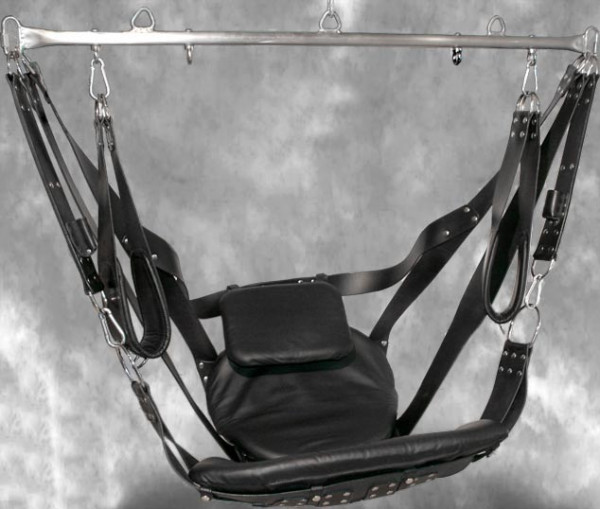
A Sling is a suspended support system consisting of a flexible seat or body support suspended from structural anchor points. Recognised as one of the defining architectural elements of modern Leather culture, it represents the development of purpose-built environments designed specifically for consensual authority traditions.
- Materials
- Leather, reinforced canvas, heavy-duty nylon, stainless steel, forged steel rings, welded steel fittings, brass hardware, webbing, chains, structural fasteners
- Origin
- Developed within the Gay Leather community of the United States during the mid-20th century; later adopted and reinterpreted by broader Leather and BDSM traditions worldwide.
- Period
- Mid-20th century to present.
- Tradition
- Gay Leather, Leather, Old Guard, Contemporary BDSM, FemDom, MaleDom, M/s, Professional Domination
Description
A Sling is a suspended support system constructed from flexible materials supported by engineered attachment points positioned above the installation. Unlike conventional furniture, its defining characteristic is that the supporting surface remains entirely dependent upon suspension rather than direct contact with the floor.
Most Slings combine reinforced leather, heavy canvas or modern synthetic materials with forged steel hardware, chains, webbing and structural anchor systems specifically designed as integral components of the installation. The supporting structure may be permanently incorporated into a building or attached to dedicated freestanding frames designed for this purpose.
Within the material culture of Leather and BDSM communities, the Sling occupies a unique position between furniture, architecture and engineered suspension systems. Its visual identity has become closely associated with dedicated clubs, studios, educational venues and private Houses, where it represents both artisan craftsmanship and the evolution of specialised environments.
History
Although suspended supports have existed for centuries in maritime, industrial and medical contexts, the modern Leather Sling emerged independently during the second half of the twentieth century within the Gay Leather communities of the United States. As permanent Leather bars and private clubs developed in cities such as San Francisco, New York and Los Angeles, craftsmen began designing suspended support systems specifically intended for these newly established cultural spaces.
By the late 1960s and throughout the 1970s, the Sling had become one of the most recognisable architectural features of many Leather venues, symbolising the emergence of permanent environments designed around the needs and aesthetics of the community itself. Its appearance reflected not merely functional considerations but also the growing confidence of a culture creating its own visual language.
During subsequent decades, the Sling was gradually adopted by many other consensual authority traditions, including heterosexual BDSM, FemDom, MaleDom, M/s relationships, professional domination and educational organisations. While its cultural significance expanded considerably, its historical origins remain firmly rooted in the development of modern Gay Leather culture.
Use in practice
Within the Lifestyle, the Sling is recognised primarily as a permanent suspension installation contributing to the architectural identity of dedicated environments. More than an individual object, it frequently forms part of the structural design of a room, reflecting long-term planning and investment in specialised spaces.
Many bespoke Slings are individually handcrafted by leatherworkers, metalworkers and specialist fabricators who combine traditional craftsmanship with structural engineering. Decorative leatherwork, forged hardware, premium materials and custom fittings frequently express the identity of individual Houses, workshops or educational venues.
Interpretations differ considerably between traditions. Some communities regard the Sling as an emblematic element of Leather heritage, while others value it principally as an example of architectural design or artisan craftsmanship. No single interpretation is universally recognised throughout the Lifestyle.
Safety
As a structural suspension system, the Sling depends upon the integrity of every component within the installation. Supporting structures, anchor points, hardware, stitching, load-bearing materials and routine inspection all contribute to its long-term preservation as a manufactured object.
Within The Instrumentarium, the Sling is documented as an artefact of material culture and engineering heritage. This entry records its historical development and architectural significance without providing operational guidance or technical instruction.
Variations
Slings exist in numerous forms reflecting differences in engineering, artisan craftsmanship and architectural integration rather than any universally accepted classification. Common variations include leather Slings, canvas Slings, four-point Slings, adjustable Slings, ceiling-mounted Slings, frame-mounted Slings, padded Slings, compact Slings, modular Slings and custom handcrafted House Slings.
Variations differ in suspension geometry, supporting hardware, construction methods, materials, adjustability and architectural integration. Many bespoke examples incorporate premium leatherwork, decorative stitching, forged metal components or custom-engineered suspension systems reflecting the identity of individual Houses or specialist workshops. These distinctions primarily represent differences in craftsmanship and engineering rather than formal categories recognised throughout the Lifestyle.
Within The Cellars
References
Brame, Gloria G., Brame, William D., & Jacobs, Jon. Different Loving: The World of Sexual Dominance and Submission. Villard Books, 1993.
Campbell, Andy. Leatherfolk: Radical Sex, People, Politics, and Practice. Nazca Plains Publishing, 2010.
Rubin, Gayle. "The Catacombs: A Temple of the Butthole." In Deviations: A Gayle Rubin Reader. Duke University Press.
Townsend, Larry. The Leatherman's Handbook II. 1983.
Taormino, Tristan (Ed.). The Ultimate Guide to Kink: BDSM, Role Play and the Erotic Edge. Cleis Press, 2012.
Wiseman, Jay. SM 101: A Realistic Introduction. Greenery Press, 1998.