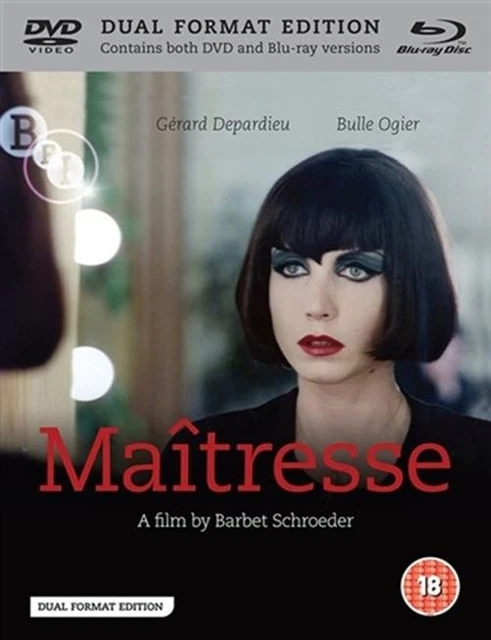
Maîtresse
by Barbet Schroeder (director), Bulle Ogier (performer), Gérard Depardieu (performer)
- Released
- 1976
- Country
- France
- Language
- French
- Studio / Publisher
- Les Films du Losange, Gaumont
- Runtime
- 112 min
- Period
- 1970s French Cinema
A chance encounter between a petty criminal and a professional dominatrix develops into an unconventional love story that explores intimacy, authority and the boundaries between professional fantasy and personal reality. Combining dramatic fiction with authentic BDSM practices, Maîtresse remains one of the most realistic and psychologically nuanced cinematic portrayals of professional domination.
The Cellars Review
Synopsis
After a failed burglary, Olivier unexpectedly discovers the apartment and professional dungeon of Ariane, an established Parisian dominatrix. Fascinated by the unfamiliar world he has entered, he gradually becomes involved in Ariane's personal life while struggling to understand the nature of her profession and the relationships she maintains with her clients.
As their romantic relationship develops, Olivier's curiosity gives way to insecurity and jealousy. He increasingly finds it difficult to separate Ariane's professional identity from her private emotions, forcing both characters to confront questions concerning trust, intimacy and personal freedom.
Rather than presenting domination as fantasy alone, the film explores the practical realities of a professional whose work exists alongside ordinary emotional relationships, creating a complex portrait of two people attempting to reconcile love with profoundly different understandings of authority, desire and independence.
Cultural Context
Released in 1976, Maîtresse emerged during a period of significant social change in France, when discussions surrounding sexuality, personal freedom and alternative lifestyles were becoming increasingly visible within European culture. Unlike many erotic films of the decade, Barbet Schroeder approached the subject with documentary curiosity, seeking to observe rather than merely exploit its controversial themes.
The production became particularly notable for incorporating authentic BDSM practitioners, real equipment and genuine professional environments into its fictional narrative. This unusual combination of dramatic storytelling and documentary realism distinguished Maîtresse from virtually every other commercial film dealing with similar subject matter during the period.
Today, the film occupies an important place within both the history of European cinema and the cultural history of BDSM representation, illustrating an early attempt to portray professional domination with psychological complexity rather than sensationalism.
Representation of the Lifestyle
Among major narrative films of the 1970s, Maîtresse offers one of the closest approximations to the everyday reality of professional domination. Ariane is neither portrayed as a mythical figure nor as a simple object of fantasy; instead, she is presented as a working professional whose occupation requires discipline, emotional control and clear separation between personal and professional life.
The film nevertheless remains a dramatic work rather than a documentary. Certain situations are heightened for narrative purposes, and the emotional conflicts between Ariane and Olivier serve the needs of the story rather than representing typical experiences within professional domination. Even so, its portrayal avoids many of the exaggerated rituals and symbolic structures commonly found in fictional representations of BDSM.
For archival purposes, Maîtresse stands as one of the earliest cinematic works to acknowledge that consensual authority exchange can exist within ordinary society rather than solely within imagined or fantastical settings.
Historical Accuracy
Although Maîtresse tells a fictional story, its depiction of professional domination contains an unusual degree of historical authenticity. Barbet Schroeder collaborated with members of the Parisian BDSM scene, filming within an authentic professional environment and incorporating genuine practices into several sequences. This documentary approach gives the film exceptional value as a cultural record of professional domination during the mid-1970s.
The interpersonal relationship between Ariane and Olivier remains fictional and should not be interpreted as representative of all professional dominatrices or their private lives. Nevertheless, many aspects of the professional setting—including equipment, etiquette, client interactions and workplace routines—reflect practices that genuinely existed within parts of the French BDSM community during the period.
As a historical document of visual culture, Maîtresse possesses considerably greater ethnographic value than most fictional films dealing with similar themes.
Themes
At its heart, Maîtresse explores the difficulty of separating professional identity from private intimacy. Ariane's occupation becomes a catalyst through which the film examines trust, jealousy and the emotional challenges that arise when two people attempt to build a relationship across fundamentally different understandings of work, desire and personal autonomy.
A second major theme concerns the tension between appearance and reality. Olivier initially views Ariane's world through the lens of fantasy and curiosity, only to discover that behind its rituals lies a structured profession governed by routine, discipline and emotional boundaries. The film repeatedly contrasts the expectations of outsiders with the lived experience of those who inhabit that world.
Finally, Maîtresse reflects upon power itself—not simply as domination or submission, but as negotiation, vulnerability and mutual dependence. Rather than presenting authority as an abstract ideal, the film asks how power operates within everyday relationships, where love, insecurity and personal freedom often prove more influential than formal hierarchy.
Artistic Significance
Maîtresse occupies a distinctive position within European cinema because it blurs the boundary between dramatic fiction and social observation. Rather than constructing an imaginary world around authority and submission, Barbet Schroeder places his fictional characters within authentic professional environments, allowing everyday reality to become part of the film's dramatic language.
The film's artistic strength derives from its refusal to sensationalise its subject. BDSM is not presented as spectacle alone, nor as moral provocation, but as one element within a broader exploration of intimacy, identity and emotional dependence. This restraint allows the audience to engage with the characters as individuals before confronting the unfamiliarity of their world.
By combining documentary authenticity with psychological drama, Maîtresse established a model rarely repeated in later cinema. Its influence lies less in visual iconography than in demonstrating that consensual authority relationships could be portrayed with complexity, ambiguity and genuine humanity.
Strengths
The film's greatest strength is its remarkable authenticity. Through careful observation, authentic locations and the inclusion of genuine professional practices, Maîtresse provides one of the closest cinematic approximations to the daily reality of professional domination produced during the twentieth century. This authenticity gives the film lasting historical as well as artistic value.
Another major strength is the performance of Bulle Ogier. Her portrayal of Ariane avoids the exaggerated stereotypes often associated with dominatrix characters, presenting instead a capable professional whose confidence, vulnerability and emotional contradictions coexist naturally. Gérard Depardieu provides an equally compelling counterbalance, allowing the audience to discover this unfamiliar world through curiosity rather than judgement.
Finally, Schroeder's restrained direction encourages reflection instead of spectacle. The film neither celebrates nor condemns its subject, preferring to observe the emotional consequences of intimacy, jealousy and personal freedom with unusual honesty.
Limitations
Although its realism distinguishes Maîtresse from many comparable films, the narrative remains centred upon the perspective of an outsider. Much of the audience's understanding of professional domination is filtered through Olivier's emotional confusion, occasionally reducing the opportunity to explore Ariane's own professional philosophy in greater depth.
The film also reflects the cultural assumptions of the 1970s. Contemporary viewers may identify attitudes toward gender, relationships and sexuality that differ significantly from present-day discussions within consensual BDSM communities. These historical perspectives should be understood within the context of the period rather than evaluated as contemporary guidance.
Certain sequences depicting authentic practices have also generated controversy because of their intensity. While historically significant, they may prove challenging for viewers unprepared for the degree of realism employed by the production.
Recommended Audience
Maîtresse is highly recommended for viewers interested in the history of BDSM representation, European art cinema, French cinema of the 1970s and the portrayal of professional domination in popular culture. It is particularly valuable for readers and researchers seeking works that move beyond symbolic fantasy toward more grounded psychological and social observation.
The film is best viewed as an historical drama informed by authentic practices rather than as a documentary or instructional representation of contemporary professional domination.
Cultural Legacy
Although never achieving the international commercial success of films such as Story of O or Emmanuelle, Maîtresse has acquired enduring recognition among film historians and scholars of sexuality for its unusually realistic approach to professional domination. Its reputation has grown steadily over time, particularly following critical re-evaluations and its restoration by major film preservation institutions.
The film also occupies an important place within the broader history of BDSM representation because it challenged prevailing cinematic stereotypes. Rather than presenting domination as exotic fantasy alone, it acknowledged the existence of a professional world governed by routine, ethics, economic exchange and emotional boundaries.
Today, Maîtresse is widely regarded as one of the most intellectually serious cinematic explorations of professional domination produced during the twentieth century.
Archivist Commentary
Within The Gallery, Maîtresse is preserved as one of the essential cinematic documents for understanding the cultural history of professional domination. Its importance lies not simply in the story it tells, but in the unprecedented authenticity with which it portrays an environment that had previously remained almost invisible within mainstream cinema.
Unlike Story of O, which approaches relational power through allegory and symbolism, Maîtresse grounds its narrative within recognisable social reality. Together, the two films illustrate two complementary traditions of representation: one mythic and philosophical, the other observational and deeply human.
For historians of the Lifestyle, this distinction is invaluable. Maîtresse demonstrates that cinema can portray consensual authority not merely as fantasy, but as lived experience shaped by professionalism, emotional complexity and the ordinary challenges of human relationships. Its preservation within The Gallery therefore serves both cinematic history and the broader historical record of relational power.
Cultural Impact
Influence on the Lifestyle
How the work affected the BDSM, Leather or Power Exchange communities — not an artistic verdict.
Unlike works such as Story of O, Maîtresse did not become a foundational myth within BDSM culture. Its influence developed more gradually through film scholarship, cultural criticism and discussions surrounding the public representation of professional domination.
Its principal contribution lies in demonstrating that consensual authority exchange could be portrayed without relying exclusively upon fantasy, exploitation or moral condemnation. By presenting professional domination as structured work carried out by recognisably human individuals, the film broadened the possibilities for later cinematic and academic discussions.
Within BDSM communities, Maîtresse is frequently appreciated less as a source of inspiration than as a rare historical record documenting aspects of European professional domination during the mid-1970s.
Public Reception
How the work was received by the general public and, where known, by the community.
Upon its original release, Maîtresse generated considerable controversy because of its explicit content and the inclusion of authentic BDSM practices. Several countries imposed censorship or demanded edited versions before public exhibition, while critics remained sharply divided between those who considered the film exploitative and those who recognised its artistic ambition.
Over subsequent decades, critical opinion evolved significantly. Film historians increasingly praised Barbet Schroeder's observational approach, Bulle Ogier's restrained performance and the film's unusual balance between realism and dramatic fiction. Modern restorations and inclusion within prestigious film collections have further strengthened its reputation as an important work of European cinema.
Archivist Assessment
Why this work is worth preserving within The Gallery.
The Cellars preserves Maîtresse because it represents one of the earliest serious cinematic attempts to portray professional domination as part of ordinary social reality rather than as fantasy alone. Although fictional, the film possesses substantial documentary value through its use of authentic environments, practices and visual detail.
Its historical importance lies not in presenting definitive truths about BDSM, but in capturing a particular moment within European sexual culture during the 1970s. When viewed alongside Story of O, Belle de Jour and The Image, Maîtresse illustrates a distinct branch of cinematic representation in which psychological realism becomes more important than symbolic ritual.
For archivists, its enduring significance rests in its ability to preserve a visual record of professional domination at a time when such worlds remained largely inaccessible to mainstream audiences.
Within The Cellars
Discussion
Sign in to read and take part in the discussion.