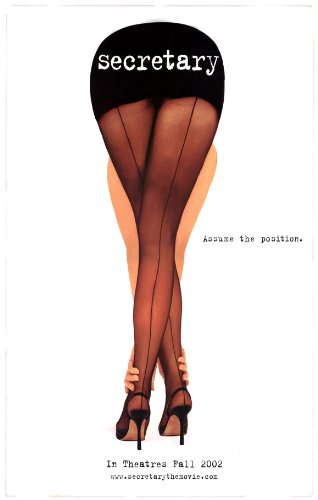
Secretary
by Mary Gaitskill (author), Steven Shainberg (director), Erin Cressida Wilson (writer)
- Released
- 2002
- Country
- United States
- Language
- English
- Studio / Publisher
- Slough Pond, double A Films, TwoPoundBag Productions
- Runtime
- 107 min
- Period
- Contemporary BDSM (2000s)
A landmark independent film that redefined the mainstream cinematic portrayal of consensual power exchange through an intimate story of trust, vulnerability and emotional transformation.
The Cellars Review
Synopsis
Following her release from a psychiatric hospital, Lee Holloway attempts to rebuild her life and accepts a position as secretary to the eccentric attorney E. Edward Grey. Their initially formal professional relationship gradually evolves into an unconventional bond founded upon authority, discipline and emotional dependence.
As both characters confront their own insecurities and past traumas, they discover that their connection cannot be understood through conventional romantic expectations. Instead, their relationship develops through a consensual dynamic of dominance and submission that challenges social norms while providing each of them with a path toward personal acceptance.
Rather than presenting BDSM as conflict or spectacle, the film uses it as the emotional language through which two isolated individuals learn to trust, communicate and ultimately find a sense of belonging.
Cultural Context
Released in 2002, Secretary emerged at a time when consensual BDSM was rarely portrayed in mainstream cinema outside the contexts of crime, exploitation or psychological pathology. Independent filmmaking of the late 1990s and early 2000s increasingly explored unconventional relationships, but few productions approached dominance and submission with comparable empathy and emotional complexity.
Adapted from Mary Gaitskill's short story, the film became one of the earliest widely distributed works to depict a consensual power exchange relationship without framing it primarily as abuse, criminality or deviance. Although not intended as an educational portrayal of BDSM, Secretary introduced many viewers to the possibility that authority, vulnerability and consent could coexist within a healthy emotional relationship.
Its cultural significance grew substantially during the following decades, particularly after the global popularity of Fifty Shades of Grey, when Secretary was frequently revisited as an example of a more psychologically nuanced and respectful representation of consensual power exchange.
Representation of the Lifestyle
Secretary does not attempt to document BDSM practice in a literal or instructional manner. Instead, it constructs a fictional relationship whose emotional foundations closely resemble many principles recognised within consensual power exchange: mutual trust, gradual negotiation, voluntary participation and the acceptance of clearly defined relational roles.
Certain aspects of the relationship are intentionally stylised for dramatic purposes, and some practical elements commonly associated with contemporary BDSM communities—such as explicit negotiation, safewords or community involvement—remain largely outside the narrative. Nevertheless, the emotional authenticity of the relationship distinguishes the film from many later mainstream portrayals.
The result is a fictional narrative that, while not comprehensive, presents one of cinema's most recognisable and generally authentic depictions of consensual dominance and submission.
Historical Accuracy
Secretary is not based on historical events, nor does it seek to reconstruct a particular period within the evolution of BDSM culture. Its significance lies instead in its accurate reflection of emotional dynamics that were already present within contemporary consensual power exchange relationships at the beginning of the twenty-first century.
The film intentionally prioritises character development over documentary realism. As a result, it should be understood as an emotionally authentic fictional narrative rather than a historical representation of BDSM communities or practices.
Themes
Secretary explores the intersection between vulnerability, authority and personal identity through a relationship that develops outside conventional social expectations. Rather than presenting dominance and submission as opposites to intimacy, the film argues that trust and emotional honesty can emerge precisely through negotiated power exchange.
A central theme is self-acceptance. Both Lee Holloway and E. Edward Grey begin the story burdened by shame, isolation and emotional repression. Their relationship gradually becomes a process through which each learns to accept aspects of themselves that society encourages them to suppress.
Communication also occupies a fundamental role. Although much of it occurs non-verbally, the evolving relationship demonstrates that authority without mutual understanding cannot endure. The emotional balance between discipline, care and respect ultimately defines the bond far more than any specific BDSM practice.
Finally, the film reflects on authenticity. Secretary suggests that personal fulfilment is achieved not by conforming to external expectations, but by honestly recognising one's own emotional needs and building relationships capable of accommodating them with mutual consent.v
Artistic Significance
Secretary occupies a unique position within contemporary independent cinema by combining romantic drama, psychological character study and unconventional relationship dynamics without reducing any of those elements to spectacle.
Steven Shainberg's restrained direction, Erin Cressida Wilson's character-focused screenplay and the performances of Maggie Gyllenhaal and James Spader create an atmosphere in which emotional tension consistently outweighs explicit sexuality. Visual composition, silence and gesture become narrative tools through which power, vulnerability and affection are expressed.
Rather than relying upon sensational imagery, the film builds its emotional impact through subtle behavioural changes and carefully observed interpersonal dynamics. This artistic restraint has contributed significantly to its enduring reputation among both film critics and members of the BDSM community.
Strengths
One of Secretary's greatest strengths is its refusal to reduce BDSM to shock value or erotic spectacle. Instead, the film presents consensual power exchange as part of a broader exploration of intimacy, trust and emotional growth.
Its nuanced character development allows both protagonists to evolve organically, making their relationship psychologically believable despite its unconventional nature. The performances of Maggie Gyllenhaal and James Spader further reinforce this credibility through subtle, emotionally layered interpretations.
The film also deserves recognition for opening a space within mainstream cinema for more complex discussions surrounding consent, authority and alternative relationship structures, influencing both later filmmakers and public conversations about BDSM representation.
Limitations
Although widely respected, Secretary should not be understood as a comprehensive representation of contemporary BDSM practice. Several elements commonly associated with modern consensual power exchange—such as explicit negotiation, community context and formal risk-awareness practices—remain largely absent from the narrative.
The relationship is intentionally stylised and constructed primarily as an emotional fable rather than a realistic depiction of everyday BDSM dynamics. Consequently, viewers seeking an accurate practical representation may incorrectly assume that emotional intuition alone replaces the communication and negotiation that characterise healthy real-world relationships.
Its symbolic storytelling is one of the film's artistic strengths, but also limits its value as a representation of the diversity and complexity of contemporary Lifestyle communities.
Recommended Audience
Recommended for viewers interested in the cultural representation of BDSM, independent cinema, psychological drama and unconventional romantic relationships. Particularly valuable for readers and researchers seeking to understand how mainstream film gradually shifted from portraying dominance and submission as pathology toward more nuanced explorations of consensual power exchange.
The film is best appreciated by audiences prepared for a slow-paced, character-driven narrative that prioritises emotional development over explicit sexuality.
Cultural Legacy
Secretary occupies a pivotal place in the history of BDSM representation within mainstream cinema. Although produced as an independent film with a modest budget, its influence has extended far beyond its original audience, becoming one of the most frequently referenced works whenever consensual power exchange is discussed in popular culture.
The film demonstrated that dominance and submission could be portrayed through emotional intimacy rather than exploitation, helping to broaden public perceptions of BDSM at a time when such relationships were still largely associated with criminality, psychological disorder or sensationalism.
Over the following decades, Secretary achieved the status of a modern cult classic. It continues to be recommended within both academic discussions of sexuality and Lifestyle communities as an example of a fictional work that approaches consensual power exchange with unusual empathy and psychological depth.
Archivist Commentary
Some works become important because they faithfully document reality. Others become important because they change the questions that audiences are willing to ask.
Secretary belongs firmly to the second category.
Rather than attempting to explain BDSM, the film quietly invites viewers to reconsider long-held assumptions about intimacy, authority and emotional fulfilment. Its greatest achievement is not the depiction of specific practices, but the normalisation of a relationship built upon mutual trust, negotiated vulnerability and personal authenticity.
More than two decades after its release, Secretary remains one of the essential cultural reference points for understanding how consensual power exchange entered contemporary cinematic discourse. Its preservation within The Gallery reflects not only its artistic merit, but its enduring contribution to the cultural history of alternative relationships.
Cultural Impact
Influence on the Lifestyle
How the work affected the BDSM, Leather or Power Exchange communities — not an artistic verdict.
Secretary contributed significantly to changing the cultural conversation surrounding BDSM in cinema. While it did not introduce the subject to popular culture, it offered one of the first widely recognised portrayals in which consensual dominance and submission formed the emotional foundation of a loving relationship rather than its central conflict.
The film has influenced later discussions surrounding intimacy, consent and alternative relationship structures, and is frequently cited in comparisons with subsequent mainstream productions, particularly Fifty Shades of Grey. In many critical and community discussions, Secretary is regarded as a more psychologically mature and emotionally authentic representation of consensual power exchange.
Its influence extends beyond BDSM itself, contributing to broader conversations about personal authenticity, neurodiversity, vulnerability and the legitimacy of relationships that exist outside conventional social expectations.
Public Reception
How the work was received by the general public and, where known, by the community.
Critical reception of Secretary was overwhelmingly positive, with particular praise directed toward Maggie Gyllenhaal's performance, Steven Shainberg's restrained direction and Erin Cressida Wilson's screenplay. Many critics recognised the film's ability to balance humour, romance and psychological complexity without reducing its subject matter to provocation.
Within BDSM communities, the film has generally been received with respect despite acknowledging its fictional nature. While practitioners often note the absence of explicit negotiation and several practical elements of real-world BDSM, Secretary is widely appreciated for portraying consent, emotional care and mutual acceptance more thoughtfully than many later mainstream works.
Among general audiences, the film has gradually evolved from an independent curiosity into a recognised cultural reference whenever cinematic portrayals of consensual power exchange are discussed.
Archivist Assessment
Why this work is worth preserving within The Gallery.
Secretary is preserved within The Gallery not because it is a definitive representation of BDSM, but because it represents a decisive moment in the cultural evolution of its portrayal.
Its historical importance lies in demonstrating that consensual power exchange could serve as the foundation for a serious, emotionally credible love story presented to mainstream audiences without relying upon exploitation or moral condemnation. Few earlier films achieved this balance with comparable sensitivity.
For the purposes of The Gallery, Secretary should be regarded as a landmark work whose influence extends beyond cinema into the broader cultural understanding of authority, consent and emotional authenticity.
Within The Cellars
Discussion
Sign in to read and take part in the discussion.