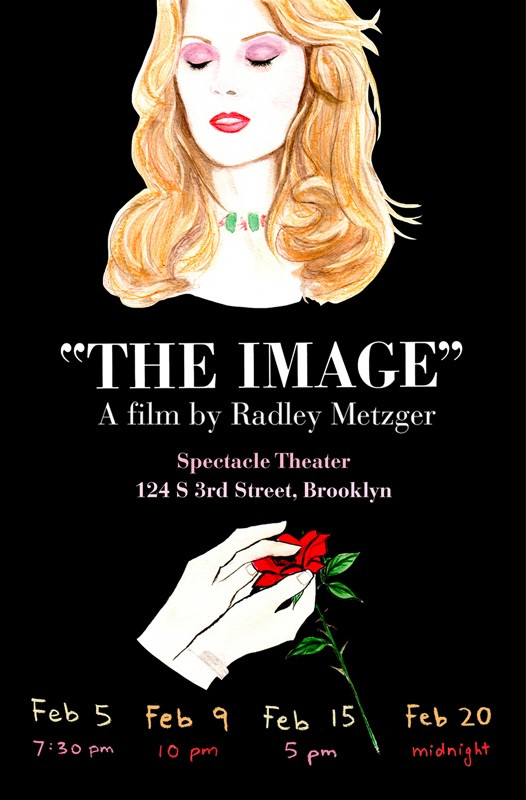
The Image
The punishment of Anne
by Radley Metzger (director), Catherine Robbe-Grillet (author), Carl Parker (performer), Marilyn Roberts (performer), Jean-Pierre Clairin (performer)
- Released
- 1975
- Country
- United States, France
- Language
- English, French
- Studio / Publisher
- Catalyst Films International, Les Films du Griffon
- Runtime
- 89 min
- Period
- Erotic Art Cinema (1970s)
A young writer becomes fascinated by an aristocratic couple whose carefully orchestrated relationship of dominance, submission and observation reveals an intricate world governed by ritual, erotic authority and psychological control. Through his gradual immersion into their private universe, The Image explores the symbolic dimensions of power exchange while remaining rooted in the traditions of European literary eroticism.
The Cellars Review
Synopsis
Jean, a young American writer living in Paris, encounters an enigmatic couple whose relationship defies conventional expectations. Georges appears to exercise quiet authority over Anne, yet their interactions reveal a far more intricate structure in which power is expressed through ritual, performance and carefully maintained roles rather than overt coercion.
Invited into their private world, Jean gradually becomes both participant and observer, witnessing a succession of ceremonies that blur the boundaries between intimacy, theatre and symbolic authority. As his fascination deepens, he is forced to confront his own assumptions about desire, obedience and emotional detachment.
Rather than following a traditional dramatic progression, the film unfolds as a sequence of ritualised encounters, inviting viewers to interpret the shifting relationships between the three central characters without ever offering definitive moral or psychological explanations.
Cultural Context
Released in 1975, The Image emerged during a decade in which European and American erotic cinema increasingly sought artistic legitimacy beyond exploitation. Drawing directly from Catherine Robbe-Grillet's novel L'Image (1956), the film reflects the influence of post-war French literary experimentation, surrealist aesthetics and the intellectual tradition surrounding the Nouveau Roman.
Unlike many erotic productions of its era, The Image presents dominance and submission not as sensational spectacle but as a carefully structured language of ritual, symbolism and emotional distance. Its emphasis on ceremony, observation and voluntary participation distinguishes it from mainstream erotic cinema and places it within a broader cultural conversation concerning desire, performance and identity.
The film occupies an important transitional position between the symbolic eroticism of works such as Belle de Jour and the later emergence of more explicit cinematic portrayals of consensual BDSM relationships.
Representation of the Lifestyle
Although The Image predates the widespread public visibility of contemporary BDSM communities, it presents one of cinema's earliest sustained portrayals of an organised dominant/submissive dynamic. Ritual, hierarchy, obedience and symbolic authority form the central framework of the narrative rather than serving merely as decorative erotic elements.
At the same time, the film reflects the cultural and literary traditions from which it emerged rather than the negotiated practices and community ethics that would later become characteristic of modern Lifestyle BDSM. Consent is largely communicated through implication and established ritual instead of the explicit negotiation commonly emphasised today.
For archival purposes, The Image is best understood as an historically significant artistic interpretation of structured power exchange rather than as a documentary representation of contemporary BDSM practice.
Historical Accuracy
Measured against contemporary BDSM culture, The Image should be regarded as partially authentic rather than historically exact. Many of its central themes—including ritual, voluntary submission, symbolic authority and structured hierarchy—anticipate concepts that would later become familiar within organised Lifestyle communities.
However, the film reflects a period before the widespread development of modern frameworks centred upon negotiated consent, community education and explicit communication. Its portrayal remains deeply influenced by European literary eroticism, where ambiguity and symbolism frequently take precedence over practical realism.
Its historical significance therefore lies less in accurately documenting BDSM practice than in preserving an important stage in the cultural evolution of artistic representations of consensual power exchange.
Themes
The Image explores dominance, submission, ritual, obedience, erotic authority, voyeurism, performance, identity, emotional detachment, symbolic power, curiosity, initiation and the relationship between observer and participant. Throughout the film, power is presented not as physical force but as a mutually sustained structure maintained through ceremony, discipline and carefully performed roles.
Rather than offering simple psychological explanations, the narrative encourages reflection upon the ways in which authority, desire and identity may become intertwined through ritualised interaction.
Artistic Significance
The Image occupies an exceptional position within the history of erotic cinema because it approaches dominance and submission through the visual language of art rather than exploitation. Adapted from Catherine Robbe-Grillet's influential novel, the film preserves many of the literary qualities that distinguished the original work: ambiguity, ritual, symbolism and emotional distance.
Rather than constructing dramatic tension through conflict alone, Radley Metzger develops a carefully controlled atmosphere in which architecture, silence, gesture and composition become integral elements of the narrative. This aesthetic discipline allows authority to emerge through ceremony instead of spectacle, making the film markedly different from most erotic productions of its era.
Its artistic importance therefore lies not simply in its subject matter, but in demonstrating that relationships structured around authority and submission could serve as the foundation for serious cinematic exploration. In doing so, The Image became one of the earliest films to treat relational power as a legitimate artistic theme worthy of careful visual and intellectual interpretation.
Strengths
The greatest strength of The Image lies in its remarkable coherence between form and subject. Every element of the production—from its restrained performances to its deliberate pacing and elegant cinematography—supports the central themes of ritual, hierarchy and symbolic authority. Rather than interrupting the narrative with explicit spectacle, the film allows atmosphere and suggestion to carry much of its emotional weight.
Another significant strength is its fidelity to the intellectual character of Catherine Robbe-Grillet's original novel. The adaptation preserves the ambiguity that defines the literary work, resisting the temptation to simplify its relationships into conventional psychological explanations. This commitment rewards attentive viewing and allows the film to remain intellectually engaging decades after its release.
Finally, the film possesses enduring documentary value as a cultural artefact. While it should not be mistaken for an accurate representation of contemporary BDSM practice, it preserves an important historical moment in which artistic cinema began exploring consensual authority relationships with seriousness, refinement and aesthetic ambition.
Limitations
Many of the qualities that make The Image historically valuable may also present challenges for modern audiences. Its intentionally measured rhythm, sparse dialogue and highly symbolic narrative demand patience and active interpretation, offering little of the immediate dramatic gratification expected from contemporary cinema.
The film also reflects the cultural assumptions of the period in which it was produced. Consent, negotiation and relational boundaries are communicated largely through implication and ritual rather than through the explicit conversations that have become central to modern Lifestyle ethics. Without historical context, viewers unfamiliar with the evolution of consensual power exchange may incorrectly interpret these omissions as representative of present-day practice.
Additionally, the characters are conceived primarily as symbolic figures rather than psychologically realistic individuals. This artistic choice reinforces the film's allegorical nature but can create emotional distance, making it more rewarding as a work of reflection than as a conventional character-driven drama.
Recommended Audience
The Image is particularly recommended for readers and viewers interested in the cultural history of erotic literature, European art cinema and the historical evolution of representations of consensual power exchange. It offers considerable value to researchers, archivists, film historians and members of the Lifestyle who wish to understand the artistic traditions that preceded the emergence of modern BDSM communities.
Because the film privileges symbolism over realism, it is best approached as an historical and cultural document rather than as an educational resource. Viewers seeking an accurate depiction of contemporary BDSM relationships may find more representative works elsewhere, while those interested in the intellectual and aesthetic origins of relational power will discover a film of lasting significance.
Cultural Legacy
Although The Image has never enjoyed the widespread recognition of many mainstream films dealing with erotic themes, its influence has endured within the narrower tradition of art cinema and the study of erotic literature. As one of the earliest serious adaptations of Catherine Robbe-Grillet's work, it helped preserve and disseminate a distinctly European vision of ritualised authority, symbolic submission and ceremonial desire.
Its importance today lies less in direct influence upon contemporary BDSM communities than in its contribution to the broader cultural vocabulary through which dominance and submission entered artistic discourse. Alongside a small number of literary and cinematic works from the mid-twentieth century, The Image forms part of the historical foundation from which later representations of relational power would evolve.
Within The Gallery, it deserves preservation because it documents an important stage in that evolution, illustrating how cinema began to treat authority, obedience and ritual as subjects capable of artistic, philosophical and cultural reflection rather than simple erotic spectacle.
Archivist Commentary
The Image is preserved within The Gallery as more than an example of 1970s erotic cinema. It records a particular moment in the cultural history of relational power, when dominance and submission were still represented primarily through literary symbolism, private ritual and aesthetic distance rather than through the language later developed by visible BDSM communities.
Its enduring interest lies in the discipline of its construction. Authority is communicated through gesture, silence, anticipation and ceremony; submission is presented not merely as an act, but as a role sustained within an elaborate relational structure. This gives the film a quality of formal ritual that distinguishes it from works concerned principally with provocation or spectacle.
That same distance requires careful interpretation. The film does not provide the explicit negotiation, vocabulary or ethical framing expected within contemporary Lifestyle representation, and it should not be treated as a model of modern practice. Its value is instead historical and cultural: it preserves an earlier artistic imagination of consensual authority, shaped by post-war European erotic literature and translated into cinema with unusual seriousness.
For the Archivist, The Image is therefore significant not because it explains the Lifestyle, but because it reveals one of the paths through which ritualised power entered the visual culture surrounding it. It invites contemplation rather than imitation and deserves to be approached as both an artwork and an artefact of its time.
Cultural Impact
Influence on the Lifestyle
How the work affected the BDSM, Leather or Power Exchange communities — not an artistic verdict.
Although The Image predates the emergence of organised BDSM communities as they are recognised today, it occupies an important position within the cultural history from which many later discussions of relational power would eventually develop. Its greatest contribution was not the establishment of practical conventions, but the preservation of a visual language in which ritual, hierarchy and voluntary submission could be explored as meaningful human experiences rather than merely sensational erotic devices.
The film introduced many viewers to concepts that had previously circulated primarily within specialised literary circles, particularly those influenced by the writings of Catherine Robbe-Grillet. By translating these ideas into cinema, it helped broaden the cultural imagination surrounding structured authority relationships and demonstrated that such themes could be approached through artistic composition, symbolism and psychological reflection.
Within the history preserved by The Cellars, The Image should therefore be understood as an influential cultural artefact rather than a formative educational work. Its legacy lies in expanding the artistic representation of consensual relational power, not in defining the ethical practices later adopted by the modern Lifestyle.
Public Reception
How the work was received by the general public and, where known, by the community.
Upon its original release, The Image remained outside mainstream cinema due both to its explicit erotic content and to the restrictive distribution environment of the mid-1970s. While commercial exposure was limited, critics and audiences interested in European-influenced erotic cinema recognised the film as unusually refined, praising its visual elegance, literary origins and measured treatment of psychological relationships.
Over time, the film has acquired a reputation as one of the most sophisticated productions within classic erotic cinema. Modern reassessments increasingly emphasise its artistic qualities, its faithful adaptation of Catherine Robbe-Grillet's novel and its importance within the broader history of cinematic representations of dominance, submission and ritualised authority. Although it has never become a widely known mainstream film, it continues to enjoy considerable respect among historians, collectors and scholars of erotic art cinema.
Archivist Assessment
Why this work is worth preserving within The Gallery.
The Image deserves preservation within The Gallery because it documents an important moment in the cultural evolution of relational power. Rather than presenting dominance and submission as isolated erotic acts, it frames them within a carefully constructed system of ritual, symbolism and interpersonal structure, reflecting a distinctly European artistic tradition that predates the development of contemporary BDSM communities.
Its historical importance does not arise from its accuracy as a representation of modern Lifestyle practice, but from its contribution to the visual and intellectual vocabulary through which authority relationships entered serious artistic discourse. Few films of its period approached these themes with comparable restraint, aesthetic discipline and literary ambition.
For these reasons, The Image should be regarded as an essential cultural document for anyone seeking to understand the artistic history of consensual power exchange. It preserves not simply a film, but a stage in the continuing evolution of how authority, obedience and ritual have been imagined within twentieth-century culture.
Within The Cellars
Discussion
Sign in to read and take part in the discussion.