A foundational work every serious library should include.
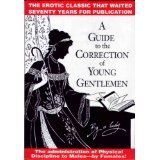
A Guide to the Correction of Young Gentlemen
The Successful Administration of Physical Discipline to Males, by Females
Originally published privately in 1924 and long believed lost, A Guide to the Correction of Young Gentlemen is one of the rarest surviving works of early British discipline literature. More than an instructional text, it provides a unique historical window into the cultural, moral, and disciplinary ideas that helped shape later traditions of female authority and corporal punishment.
- Author
- Alice Kerr-Sutherland
- First published
- 1924
- Current edition
- 1991 Delectus Books Reprint
- Edition notes
- Reprinted from the original private edition of 1924. The original edition was reportedly limited to one hundred copies, all of which were believed to have been seized and destroyed following a police raid in October 1924. This edition includes a substantial historical introduction documenting the provenance of the work and the circumstances surrounding its suppression.
- Publisher
- Delectus Books Limited
- Language
- English
- ISBN-10
- 1897767056
- ISBN-13
- 9781897767054
- Type
- Historical
- Tradition
- Historical BDSM
- Period
- Interwar Britain (1920s)
- Topics
- Corporal PunishmentFemale AuthorityDomestic DisciplineBritish Discipline LiteratureHistorical BDSMFlagellationGender RolesVictorian LegacyEdwardian InfluencePower ExchangeDiscipline FictionFemDom History
- Tags
- Alice Kerr-SutherlandA LadyCorporal PunishmentDisciplineFlagellationFemale DominanceHistorical BDSMBritish Fetish HistoryDomestic DisciplineSpankingCaningDiscipline LiteratureFemDomCP LiteratureInterwar Britain
Suggested citation
Kerr-Sutherland, A. (1924). A Guide to the Correction of Young Gentlemen: The Successful Administration of Physical Discipline to Males, by Females (1991 Delectus Books Reprint). Delectus Books Limited.
The Cellars Review
Abstract
A Guide to the Correction of Young Gentlemen presents a systematic philosophy of female-administered corporal punishment, framed as a method for correcting the character and behaviour of boys and young men. Written under the pseudonym "A Lady", the work combines practical discussions of discipline with broader reflections on authority, education, morality, and the perceived responsibilities of women as moral guardians.
Rather than approaching corporal punishment solely as a punishment, the author presents it as a structured educational process intended to cultivate obedience, self-control, humility, and respect for authority. Throughout the text, different female authority figures—including the Mother, Nurse, Governess, Schoolmistress, Mistress, and Dame—are portrayed as embodying distinct disciplinary roles appropriate to different stages of a young man's development. :contentReference[oaicite:0]{index=0}
The 1991 Delectus Books edition significantly expands the historical value of the work through its extensive introduction, which documents the history of the original publication, its suppression following a 1924 police investigation, the later attribution of the text to Alice Kerr-Sutherland, and its rediscovery after decades during which it was believed to have been completely destroyed.
Historical Context
First published privately in 1924, A Guide to the Correction of Young Gentlemen belongs to the small body of early twentieth-century British discipline literature that emerged alongside Victorian and Edwardian traditions of corporal punishment, domestic authority, and fetish publishing. Although presented as an instructional treatise, the work occupies a complex position between educational theory, erotic imagination, and the clandestine literature of its period.
According to the historical introduction included in the 1991 Delectus Books reprint, the original edition was reportedly limited to one hundred copies before being seized during a police investigation connected with the publisher Charles Carrington Hamer. For many decades the work was believed to have been completely destroyed, contributing to its almost legendary status among collectors of historical discipline literature. The same introduction also presents the evidence supporting the attribution of the work to Alice Kerr-Sutherland, whose surviving writings display striking similarities in both philosophy and style. :contentReference[oaicite:2]{index=2}
Today the book is valued less as a practical manual than as a rare primary historical source documenting attitudes toward discipline, gender, authority, and corporal punishment in interwar Britain. It provides important insight into ideas that would later influence the development of female-dominance literature and the historical roots of consensual discipline within modern BDSM culture.
Main Subjects
The book explores the philosophy, structure, and practice of female-administered corporal punishment through the fictional framework of correcting young gentlemen. Central to the work is the concept that discipline should be systematic, purposeful, and administered by women occupying recognised positions of authority. The author develops a complete disciplinary model that encompasses rules of conduct, behavioural correction, methods of punishment, the progressive escalation of sanctions, and the symbolic relationship between authority and obedience.
A substantial portion of the text is devoted to the organisation of disciplinary regimes. Individual chapters examine the responsibilities of different female authority figures, standards of dress and appearance, household routine, non-corporal punishments, corporal punishment techniques, the use of the birch, the calculation of offences, and contractual arrangements between disciplinarian and subject. These elements are presented as parts of a coherent disciplinary philosophy rather than as isolated practices. :contentReference[oaicite:0]{index=0}
Beyond its explicit subject matter, the work provides valuable insight into the cultural imagination of early twentieth-century British discipline literature. Themes of hierarchy, ritual, correction, shame, obedience, moral development, and female authority are woven throughout the narrative, making the book an important primary source for understanding the historical evolution of Female Dominance, disciplinarian traditions, and the symbolic foundations from which aspects of modern consensual BDSM later emerged.
Strengths
The principal strength of A Guide to the Correction of Young Gentlemen lies not in its instructional value for contemporary readers, but in its exceptional historical significance. As one of the very few surviving examples of early twentieth-century British discipline literature, it provides direct access to the language, symbolism, and philosophical framework that characterised an important strand of pre-war disciplinary culture.
Unlike many later works, the text presents a remarkably complete internal system. Female authority is organised into distinct archetypes—including the Mother, Nurse, Governess, Mistress, and Dame—each representing a different stage in the moral and disciplinary development of the male subject. This structured worldview offers valuable insight into the evolution of female-dominance narratives long before the emergence of modern BDSM terminology.
The 1991 Delectus Books edition further enhances the work through its extensive historical introduction, which documents the circumstances of the original publication, its suppression, probable authorship, and eventual rediscovery. As a result, this edition functions both as a reproduction of a rare historical document and as an important piece of editorial scholarship.
Limitations
The book should not be read as a contemporary guide to BDSM, consent, or ethical power exchange. Its arguments are rooted in the social values, educational assumptions, and disciplinary philosophies of interwar Britain, many of which are incompatible with modern understandings of consensual BDSM relationships.
The text deliberately adopts the language of educational discipline while employing an obvious coded narrative directed toward adult male flagellant fantasy. Modern readers should therefore approach the work as a historical artefact rather than as practical instruction. Many of its assumptions concerning gender roles, authority, punishment, and child-rearing reflect the cultural attitudes of its period and should be understood within that historical context rather than interpreted as contemporary recommendations.
For these reasons, the greatest value of the work lies in its documentary importance. It preserves a rare example of early British discipline literature and illustrates the intellectual and cultural foundations from which later consensual female-dominance traditions would eventually develop.
Recommended Audience
Historians, Researchers, BDSM educators, FemDom practitioners, Historical BDSM enthusiasts, Leather historians, Cultural historians, Collectors of historical BDSM literature, Advanced practitioners, Students of British social history
Legacy
Although almost unknown outside specialist circles for much of the twentieth century, A Guide to the Correction of Young Gentlemen has become one of the most important surviving documents of early British discipline literature. Its survival is remarkable in itself, given that the original 1924 edition was believed to have been entirely destroyed following police seizure, and its later rediscovery transformed it into a significant historical source for researchers of erotic publishing, corporal punishment, and female-dominance literature. :contentReference[oaicite:1]{index=1}
Beyond its rarity, the work occupies an important place in the genealogy of modern BDSM. It documents a period in which fantasies of discipline, authority, ritual, and correction were expressed through coded educational narratives rather than the explicit terminology that would emerge later. As such, it helps bridge Victorian and Edwardian flagellation literature with the later development of consensual Female Dominance and historical BDSM traditions.
Today the book is valued less for its practical content than for its contribution to the documentary history of the Lifestyle. It remains an essential primary source for understanding the cultural origins of British discipline traditions and the evolution of female authority within erotic literature.
Archivist Commentary
The Library of The Cellars preserves not only works that teach the Lifestyle, but also those that explain where its traditions came from. A Guide to the Correction of Young Gentlemen belongs firmly in the latter category. It is preserved as a historical document rather than as a contemporary instructional manual.
Its importance lies in the rare opportunity it offers to examine the language, symbolism, moral assumptions, and disciplinary philosophy that influenced an important strand of early British Female Dominance. Whether read as coded fantasy, historical curiosity, or cultural artefact, the work provides valuable evidence of how authority, correction, ritual, and discipline were imagined during the first decades of the twentieth century.
The accompanying 1991 scholarly introduction significantly increases the value of this edition by documenting the history of the book itself—its suppression, presumed destruction, probable authorship, and eventual rediscovery. Together, the original text and its editorial commentary preserve a chapter of BDSM history that might otherwise have been lost entirely. For that reason, this edition deserves its place among the foundational historical sources of The Library.
Within The Cellars
Discussion
Sign in to read and take part in the discussion.